The Beautiful
Forty-eight years ago today, tragic consequences came to a quiet Bible college in the North Georgia mountains. Now a heedless, soulless administration shows we still have much to learn.

Some disasters are both foreseeable and foreseen. Others seem to come from nowhere. If we look hard enough at some of the surprising ones, we might find that there were clues if anyone paid attention.
But we seldom do so. That’s a lesson for pretty much everything.
No one should be surprised, for example, that Donald Trump failed to deliver on his promise to stop inflation on Day 1. No one can stop inflation on Day 1, Day 2, or any day. This is not a revelation. No mature adult should have believed him.
Neither is it surprising that cutting off food will make children go hungry. Or that baked-in structural failures keep producing poverty. Or that when someone sends the National Guard to quell riots that occurred only in the sender’s delusions, the troops, bored and embarrassed, wind up on trash detail.
Neither is it surprising that engineering rules still apply even when people ignore them. Some deadly things are real. If no one acts to fix them, bad things will come.
Today is the forty-eighth anniversary of one of those tragic events that happen when blameless people are in the path of foreseeable consequences.
Just outside the town of Toccoa, in the mountains of northeast Georgia, sits Toccoa Falls College, which has taught evangelical Bible believers and preachers since 1911. Toccoa Creek runs through the campus.
Local lore says Toccoa comes from the Cherokee term for the beautiful, a story repeated so often that it has become accepted as fact. That name origin is almost certainly not true, but that makes the place no less beautiful.
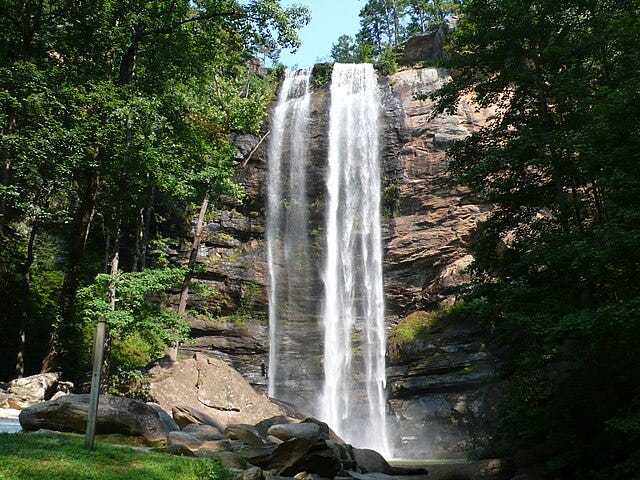
A short walk along Toccoa Creek on campus leads to the box end of a narrow, forested gorge. Here the creek cascades one hundred eighty-six feet to form Toccoa Falls, one of the many graces of the North Georgia Blue Ridge. The college says God has marked the place in a special way.
In 1899, a landowner dammed Toccoa Creek for hydroelectricity. The site was a little less than half a mile upstream of the falls, above the future college. The college later bought the falls, dam, lake, and hydro plant. By the mid-1970s, the last power turbines were gone, but the Kelly Barnes Dam, 400 feet long and 38 feet high, and its 40-acre lake remained.
The college frequently rebuilt and revised the dam, but never, apparently, with professional design drawings, construction documents, or maintenance plans. At one point, a Toccoa Falls College student doubled as a welder on the dam’s pipework.
On Wednesday, Nov. 2, 1977, heavy rain began and sat for days over the mountains. By Saturday night, seven inches had fallen in the Toccoa Creek watershed. The soil was saturated, including the dam’s slopes and crown.
A worried local firefighter went to check the dam late Saturday night. It looked intact. Oddly, however, he saw no water going through the spillway, where it should have been. It had to be going somewhere else.
Another report, unconfirmed, said the lake level was dropping—another sign of escaping water. But no alarm went up.
About 1:30 a.m. on Sunday, Nov. 6, the dam collapsed. In an instant, all the lake’s water rushed downhill, over the falls, into the narrow, funneling gorge, and onto the little campus like a shotgun.
In seconds, the water filled creekside dorms to their ceilings. It smashed houses and trailers of college families into splinters and piled them up against a bridge a mile downstream.
The flood killed thirty-nine people. Twenty were children of college faculty and staff.
“I don’t understand it, Lord,” one of us heard a student cry out that morning. I had arrived to cover the story as a rookie newspaper reporter, just three weeks into my first post-college job. Sunday was the first of many days working in hip-deep mud.
The response was massive—media, rescuers, even First Lady Rosalynn Carter, who flew in to represent the administration. When she reported back, the president ordered the Army Corps of Engineers to inspect non-federal dams nationwide.
Federal dams were already inspected and documented. The others were the worry. Jimmy Carter, an engineer by training, told the corps to find out what other calamities might be threatening the sleep of innocents.
The U.S. Geological Survey and other agencies also began their investigation of the collapse. They spoke to people and looked at old reports, yearbook and student newspaper archives, maps, and photographs.
Photos showed the dam thickly covered with trees and shrubs. Grass on an earthen dam can hold surface soil in place. Properly maintained, it can be an important way to keep a dam intact. But the roots of trees and woody shrubs dig deeper, breaking the soil and weakening the dam. Trees are an important reason why neglected dams fail.
Investigators also found evidence of old pipes running through the dam that were never fixed, soft spots seen on the banks that were never fixed, a slumping of dirt on the downstream side that was never fixed, and other problems that were never fixed.
As nearly always, the investigators didn’t pin the failure on just one cause. This combined with this and added to this resulted in this. The collapse was the cumulative outcome of seventy-eight years of compounded bad decisions, each of which, we can charitably guess, probably seemed harmless at the time.
The principles that might have saved people’s lives—choose a dam’s location with care, have professionals design and build it, and once it’s built, take care of it—were known when the first owner built the dam’s first version, and they were known when the last version collapsed.
Another principle, demonstrated at Toccoa Falls in 1977 and in Central Texas in summer 2025, is don’t put college or summer-camp residential halls in potentially deadly floodplains.
None of those principles is a revelation.
But none is exactly an indictment either, if that means bad intent. This was not some auto executive burying the engineers’ warnings because not enough families would die screaming in fires to justify the cost of the fix.
It wasn’t even like a launch director’s calculation that the chance of the space shuttle exploding on a cold January morning was too small to worry about.
It was more like a benign faith in the way things have always been: The dam has been there this long. Its collapse was a surprise.
Except that it wasn’t.
Sometimes we fool ourselves. A driver who habitually tailgates others at ninety mph probably will never cause a crash that kills somebody else’s children. The driver mistranslates this as will never.
Such magical thinking is no basis for grown-up decisions about anything, including a country. But it keeps coming back.
That recognition was perhaps the New Deal’s greatest moral breakthrough, for which we thank FDR’s labor secretary, Frances Perkins: that every human action or inaction has a human result. Grinding a person, a family, or a generation beneath hunger, pain, and despair will have its consequences, and they will be deep and lasting. There is no stroke that leaves no mark.
Today the denial of that truth fuels the Trump administration’s pretend Roaring 2020s.
It’s OK if a generation of kids skip their vaccines, or some meals, or breathe poisonous air—probably no serious consequences right away, and anyway, it’s them, not us.
It’s OK if we slash cancer research, space research, climate research, gun-violence research—the world won’t end, and anyway, it’s not us.
It’s OK if we dance in grotesque splendor while the hopeless and hungry wait outside— “a little party never killed nobody,” at least nobody we can see. And anyway, they’re not us.
Which brings us back to why the dam collapse, forty-eight years later, isn’t just ancient history.
You will hear, these days, that this inspection for listeria is a waste of taxpayer dollars, or that this rule limiting radioactive products is communism, or that caring about clean water or safe dams is deep state wokeness.
When you hear that, try imagining this.
It’s midnight. You have been up late at Bible study, and you have to be up again before dawn for Sunday services. The rest of the campus sleeps.
But for a moment, you lie awake in your dorm room, with no radio or other human sound other than your own breath, which at this hour, in this dark, seems like a gift.
You have the window open. Through it comes the steady sound of God’s perfect rain, falling and falling, keeping you and your little school safe, adding its blessing each hour to Toccoa Falls.
The Beautiful.
Powerful writing. As we rest next to those open windows, we know the inevitable flood, when it comes, will affect us all.