Someday at Christmas
A quiet, gentle song from six decades ago is as timely today as ever.

Murder and degradation have stalked the land this season. December, when night lengthens, is at least by reputation also a time of light: Christmas and Hanukkah candles and the private light cast by good people of every faith or no faith.
But they face a challenge.
The worst parts of us seem biggest and boldest. Volume may be no substitute for virtue, but it’s hard to make that point while the loudmouth yells. Cynicism is so exhausting because it is so easy and unceasing.
Still, there are moments when, as Leonard Cohen said, the crack lets the light in. Or the music. We might hear the chimes start and then for nearly three minutes we hear someone assure us that we aren’t the only ones.
Someday at Christmas men won’t be boys,
Playing with bombs like kids play with toys.
One warm December out hearts will see
A world where men are free.
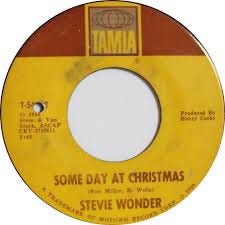
The singer is Stevie Wonder, his voice still pitched high at age 16 but already showing the fluidity and emotion that would make him a global force. The song is “Someday at Christmas.” It has been covered over and over, including by Wonder in a 2015 duet with Andra Day.
The original, for me, is still the archetype of the song’s innocence and unapologetic hope.
The lyrics are by Ron Miller. The melody is by Bryan Wells. Miller and Wells were then a songwriting team at Motown, where their compositions for Wonder also included “A Place in the Sun” and “Yester-me, Yester-you, Yesterday.”
They wrote “Someday at Christmas” in 1966, when the unfinished fight for equality was transitioning. Dr. Martin Luther King Jr. was speaking about economic inequity, which would take more than new civil rights laws to remedy.
Meanwhile, President Lyndon B. Johnson, who had signed those laws, also had vowed that the United States would fight in Vietnam until the communist North gave up. Americans were just beginning to understand the horror of the president’s delusion.
“Someday at Christmas”—released as a single on Motown’s Tamla label on Nov. 22, the third anniversary of the JFK assassination—captures the moment.
Someday at Christmas there’ll be no wars
When we have learned what Christmas is for
When we have learned what life's really worth
There'll be peace on earth.
Miller died in 2007. This week I reached out to Bryan Wells to ask about their collaborations. He responded generously to a stranger’s inquiry about a song he co-wrote six decades ago.
He wanted people to know about his friend and partner.
“Not only was Ron a great guy,” Wells told me, “but he was one of the giant lyricists of pop music.”
In 1966, Wells was playing his way through college as a pianist when Miller approached him at a gig Wells had gotten because someone else got sick. Miller told Wells he had liked what he heard and said he needed a new composing partner—at Motown.
That year, Motown was filling radios with Stevie Wonder, the Supremes, the Temptations, the Four Tops, Marvin Gaye, Martha and the Vandellas, and other royalty of American culture. For Wells, it seemed like music heaven had opened.
The two quickly developed a working method.
“My writing process with Ron was quite simple,” Wells wrote in an email. “I wrote the melody and then he wrote the lyrics. That was always our MO.”
A finished song is a different thing than its parts. When it works, words and notes become an entity.
“Sometimes he would ask me to play the melody many times to give him some live inspiration,” Wells said. “And the rest of the time he would work with a recording I would make for him.”
For “Someday at Christmas,” Wells created patterned phrasing and a gentle melodic fall for each line that stirs reflection and contemplation, while its key changes, rising a half-step at a time to end in C major, signal a climb toward optimism and hope.
It’s a melody that understands something about the heart. Some great Christmas music is about glory written across the night sky and trumpets proclaiming the glad tidings. But some is less triumphant, more like the little family in the stable facing fear and worry, wondering if they will have strength just to survive in a hostile world, much less change it.
That was the secret Miller unlocked in Wells’ melody. Here is his concluding verse:
Someday at Christmas man will not fail,
Hate will be gone and love will prevail,
Someday a new world that we can start
With hope in ev'ry heart.

Someday all our dreams will come to be,
Someday in a world where men are free,
Maybe not in time for you and me,
But someday at Christmas time,
Someday at Christmas time.
Today, Bryan Wells has an outro—a song’s musical conclusion—for what his friend discovered.
“Ron truly wrote lyrics of great profundity,” he said.
“May Ron’s lyrics in the song become a reality.”